On Monday afternoon, two days before the end, I opened frontierqueue.gi the way Gibraltarians have opened it
for years — the reflex before the drive, the glance before the weekly shop in Spain that nobody enjoys but
everybody does. The cameras wouldn't connect. The status line read NO QUEUE. And on Wednesday, under
the treaty, there will be no queue to check, ever again.
I should be nothing but glad. That border has been used as an instrument against us for as long as anyone
living can remember — shut in our faces for sixteen years, squeezed and slowed and weaponised in the decades
since. And yet my relationship with it is more complicated than gladness. It stood there my whole life
pretending to be a safety net, and I let it pretend, even knowing the net was mostly imaginary. Call it what
it is: something close to Stockholm syndrome, felt by an entire people for a line of steel and booths.
So before the memory fades — and it will fade, faster than we think — this is the record. Of what the fence
was, what the queue did, who suffered in it, and why the fluidity we gained this week mattered enough to trade
our beloved illusion for it. Lest we forget.
Every dated claim below is drawn from the contemporary record — government archives, parliamentary evidence,
the European Commission, and the local and international press. Sources are linked throughout and listed in
full at the end.
A note on the name
We never called it la Verja
In the Spanish press this week, what is coming down is la Verja — the railing, the fence. The word
carries an entire argument inside it. A fence needs no border post, because in that telling there is nothing
on the other side but more Spain: Spanish territory separated from Spanish territory by a foreign occupier's
ironwork. Gibraltar Español, compressed into two syllables.
Gibraltarians never called it that. To us it was, simply, the frontier — a word that concedes
nothing, because a frontier is what lies between two peoples and two territories. You queued at the frontier.
You checked the frontier queue. You timed your shop around the frontier. The word was part of who we were, and
it still is.
So when you read, this week, that "la Verja" is being dismantled at last, read the word as carefully as the
news. What is being removed is border infrastructure between two distinct peoples, by treaty, with Gibraltar's
consent. What some on the other side hope is being removed is the distinction itself. This page is called
The Frontier because the words are part of the record too — and because the argument over them does
not come down with the booths.
A seven-foot iron fence is erected by Britain across the neutral ground, to cut the cost of sentries —
and, most accounts add, the smuggling of tobacco. In Spain it will come to be known, pointedly, as
la Verja — merely "the railing". In Gibraltar it becomes the frontier. Nobody imagines it will
stand for 117 years, or what will be done with it.[1][2]
Queen Elizabeth II calls at Gibraltar on her Coronation tour. General Franco treats the visit as an
affront, and the squeeze begins: no new passes for Spanish frontier workers, restrictions layered upon
restrictions. The border becomes an instrument of policy — and stays one for the rest of its life.[3][4][32]
After Spain takes its claim to the United Nations, the harassment escalates year by year: special passes
demanded of Gibraltarians, British passports refused recognition, vehicle and customs restrictions,
Spanish women withdrawn from their Gibraltar jobs. In September 1967, asked to choose between British
sovereignty and Spanish, Gibraltar answers by 12,138 votes to 44.[5][6]
In response to Gibraltar's new Constitution, Franco orders the frontier closed. The telephone lines are
severed too. The ferry to Algeciras makes its final crossing weeks later. Families are separated overnight
— grandmothers from grandchildren, sisters from brothers — for thirteen years for those on foot, sixteen
for everyone else.[7][8]
4,666
Spanish workers lost their Gibraltar jobs
13
Years closed to pedestrians
16
Years until vehicles crossed again
Newsreel, June 1969: Spanish workers leave Gibraltar in the week Franco closes the frontier. AP Archive.
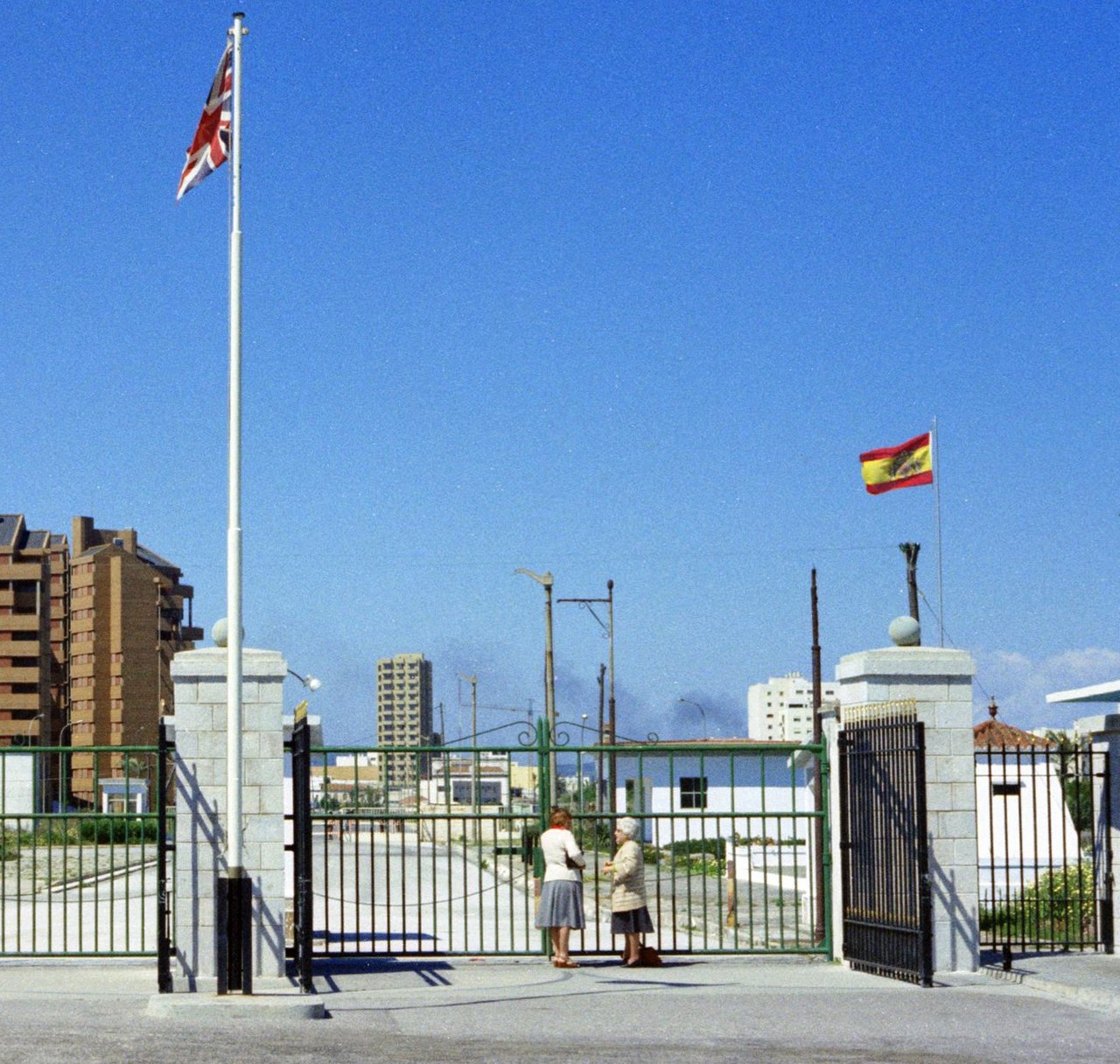
The gates, shut: the closed frontier photographed from the Gibraltar side in 1977 — year eight of
sixteen.
Photo: Elmar Reich, CC BY-SA 2.0, via Wikimedia Commons
With the gates locked and the phones dead, families gather at either side of the fence and shout their
news across the neutral ground — engagements, births, and worse.
They would shout across and there would be this conversation in the air… deaths would be announced by
shouting across.
To embrace a dying relative standing metres away, Gibraltarians sailed to Tangier and back across the
Strait to Algeciras — hundreds of kilometres of sea to cross one hundred metres of land.[9]
The monument in La Línea to the Spanish frontier workers of Gibraltar — the men who cycled across every
morning until the gates shut in June 1969, and whose jobs, and families, ended at the fence.
Photo: public domain, via Wikimedia Commons
Franco's embargo severs every supply line from Spain: food, fresh produce, labour. Gibraltar pivots
seaward — Moroccan workers replace the expelled Spanish workforce, and the Mons Calpe ferry brings fruit,
vegetables, fish and even oxygen for the hospital across the Strait from Morocco.[8]
The dependency the blockade exposed outlived it by decades: until 2020, the liquid oxygen for St Bernard's
Hospital was topped up from a depot in San Roque and its cylinders refilled in Jerez — Gibraltar's
hospital air, crossing the frontier. Only with Brexit looming did the GHA buy its own oxygen plant, which
arrived, by grim good fortune, just as the pandemic did.[10]
Colour home-movie footage, 1965: boarding the Mons Calpe in Gibraltar and sailing for Tangier — the
route that became Gibraltar's lifeline through the closed years.
Felipe González's first cabinet reopens the frontier to pedestrians alone. Crowds press through just after
midnight. It takes the Brussels Agreement of November 1984 — and Spain's need to join the European
Community — before the gates open fully on 5 February 1985. By April 1986, nearly 13,000
pedestrians and over 3,000 cars are crossing daily. In April 1985 Sir Joshua Hassan pays a conciliatory
visit to the Campo — the first official trip to Spain by a Gibraltar Chief Minister since restrictions
began in 1964.[11][12]
The Gibraltar National Archives' documentary on the closure years and the 1985 reopening — archival
footage throughout. HM Government of Gibraltar, 2025.
Gibraltar arrests the crew of a Spanish trawler fishing illegally. Spanish fishermen blockade the frontier
outright for two days; the Spanish state then throttles it for months — average delays leap from twenty
minutes to a minimum of thirty-eight, on a number of occasions exceeding three hours, with throughput cut
to a third. The Prime Minister, Tony Blair, calls the retaliation "unacceptable and unjustifiable". Four
thousand Spanish workers are caught in it too — the queue never did check whose side you were on.[13]
Gibraltar drops seventy concrete blocks to build an artificial reef; Madrid answers with "exhaustive"
checks. On the last weekend of July the queue reaches six hours in 30° heat. An ambulance crew goes
into the queue to treat the trapped; the elderly and children suffer worst; ministers walk the
lines handing out thousands of bottles of water — and six thousand paper cups. Spain's foreign minister
threatens a €50 crossing fee and closure of airspace, declaring "the party is over". Fabian Picardo
answers that García-Margallo's statements are "more reminiscent of the type of statement you'd hear from
North Korea than from an EU partner".[14][15][16]
AP Television, 7 August 2013: the tightened checks and the queues they made.
Unacceptable border delays of up to four hours continue to impact on peoples' lives in and around
Gibraltar… We remain confident that the Spanish government has acted – and continues to act – unlawfully,
through introducing disproportionate and politically motivated checks.
The European Commission sends monitoring missions to the frontier in September 2013 and again in 2014. It
stops short of finding an infringement — but issues Spain formal recommendations: more lanes, risk-based
checks in place of blanket random controls, and cooperation against tobacco smuggling.[17][18]
Gibraltar's Frontier Monitoring Programme — cameras and flow counters trained on the crossing — records
the mechanics of an engineered queue in a single day's data:
7.8
Cars per minute, 2 pm
1.5
Cars per minute, 6 pm
12.7
Cars per minute, 7 pm — tap reopened
The drop in cars crossing the border from 12.7 cars per minute to 1.5 is undeniable proof of the way in
which delays are being generated.
Somewhere in these years the queue acquired its own media. frontierqueue.gi — two cameras, a timestamp, an
estimate — became the page Gibraltarians checked before every crossing, the pre-drive ritual, the tab that
decided whether you did the Spanish shop today or surrendered and stayed home. On the worst Sunday of the
2013 crisis it took almost thirty thousand hits — ten times normal — from Gibraltar, Spain, Britain and
beyond. Its quiet second job: gathering the evidence Gibraltar sent to Brussels.[20][19]
GIBRALTAR FRONTIER QUEUE● LIVE
Connecting to camera
Monday 13 July 2026 · 16:06 — Estimated queue from Eastgate: NO QUEUE
frontierqueue.gi as captured two days before provisional application of the Treaty. The cameras never
connected. The status line, for the last time in its intended sense: no queue.
Gibraltar is the first place in the entire United Kingdom referendum to declare: 19,322 to 823 — 96 per
cent — to remain in the European Union. The vote changes nothing and everything. The decade that follows
will be spent negotiating our way out of the consequence of a decision we opposed almost unanimously —
and, in the strangest turn of all, that negotiation will end by dismantling the fence itself.[21]
In the post-Brexit limbo, Spain begins refusing entry to Gibraltar ambulances crewed by Gibraltar
residents, treating paramedics like commercial drivers. Routine patient transfers stop unless the crew
lives in Spain or holds EU nationality; emergency crossings are limited to "life or death" cases with
prior notice; even platelet supplies from Jerez are disrupted. It takes until the treaty era for
ambulances to cross freely again.[22][23]
Without notice, Spain begins stamping every passport at the frontier; morning traffic grinds to a halt
between 7am and 8am. Picardo answers in kind — reciprocal controls at entry to Gibraltar, briefly imposed
the following morning — declaring "we will not be forced to submit through pressure tactics." Spain stands
down before lunchtime. It is, though nobody knows it yet, the queue's last great performance.[24][25]
Hours before the Brexit transition expires, the UK and Spain agree a framework: Gibraltar as a
Schengen-connected territory, the hard border averted. Four years of negotiation later, on 11 June 2025 in
Brussels, the political agreement lands — Šefčovič calls it "a truly historic milestone". Spain's foreign
minister José Manuel Albares chooses words that would once have been unsayable in Madrid:
With this agreement, the fence, the last wall of continental Europe, will disappear and the free movement
of people and goods is guaranteed.
The treaty — described in Gibraltar as the most significant accord since Utrecht in 1713 — is signed in
Brussels on Tuesday 14 July and provisionally applied the following day. From Wednesday 15 July, routine
checks at the land frontier end. Schengen controls move to Gibraltar's airport and port, operated
alongside Gibraltar's own. Some fifteen thousand daily workers cross freely. On the Spanish side, sections
of fence and inspection booths are already coming down; the Spanish Prime Minister is due at La Línea for
the demolition of the rest. A UK–Gibraltar concordat provides that Gibraltarians could, by referendum,
ultimately bring the arrangement to an end — the safety net, this time, written down.[27][29][30][31]
The crossing from the La Línea side: the monument to the Spanish frontier worker in the foreground, the
Rock beyond — two communities the frontier punished together.
Photo: Nathan, CC BY-SA 3.0, via Wikimedia Commons
Here is the part that is harder to write. Everything above is the case for celebration, and I do celebrate it.
Or at least, I expect I will, in due course. Nobody will miss timing the return from the supermarket shop
against the webcam. No child should ever again pass a summer afternoon in a stationary car at the line, and
now none will.
But the frontier was also, for people like me, a kind of promise — the visible edge of home, the place where
Gibraltar stopped being negotiable. For many years, I remember, we'd all remove our seatbelts when driving
back into Gibraltar. We would all breathe a different air when we were driving across the runway to get home -
this too, consigned to a memory that is fading quickly. We're told the protection it offered was largely
illusory even when we stood outside Schengen; that our border guards rarely turned anyone away. And I think I
believe it. The net was imaginary, but it was no less real. I loved it anyway, the way you love anything that
stood between you and the world for your whole life, even when it mostly stood there hurting you.
And it is also true that, in 2026, there's an added, and harder, edge to this that hurts just to articulate.
On the other side, in the political 'hinterland', the machinery that spent a century insisting we are not a
people has not been dismantled along with the booths — it runs at full throttle still. Every time a Spanish
headline celebrates the final removal of la Verja — their word, carrying their claim — it's like a
stake to the Gibraltarian heart, no matter what the objective, cool-headed analysis tells us. I know the
reality too. The treaty's architecture is precise about what we are: a separate territory and a separate
people, with checks relocated but never surrendered, and our consent written into the foundations. My head has
read the texts. My heart does not understand them quite so plainly. I suspect I am not the only Gibraltarian
living in that gap this week.
That is the complicated truth this page exists to hold: both things at once. The queue was an instrument of
coercion, and we are right to be rid of it. And it was ours — our grievance, our ritual, part of the proof of
who we were, or at least are, for some time — and some of us will feel its absence like a missing tooth,
tonguing the gap for years. If you feel a flicker of trepidation this week, you are not disloyal and you are
not alone. You are also not an idiot. You are simply someone whose history had, as a core participant, for
better and for worse, a border fence demarcating the line in the sand.
GBC News asks Gibraltarians the question this page is trying to answer: would you be happy with the fence
coming down? June 2025.
We did not lose the safety net. We traded an illusion of one for a real thing: fluidity, treaty, and a written
guarantee that the last word on all of it stays where it has always belonged — with the people of Gibraltar.